
Olympic Peninsula Steelhead Won’t Get ESA Protection—Despite “Moderate Risk of Extinction”
 February 16, 2026
  0 Comments
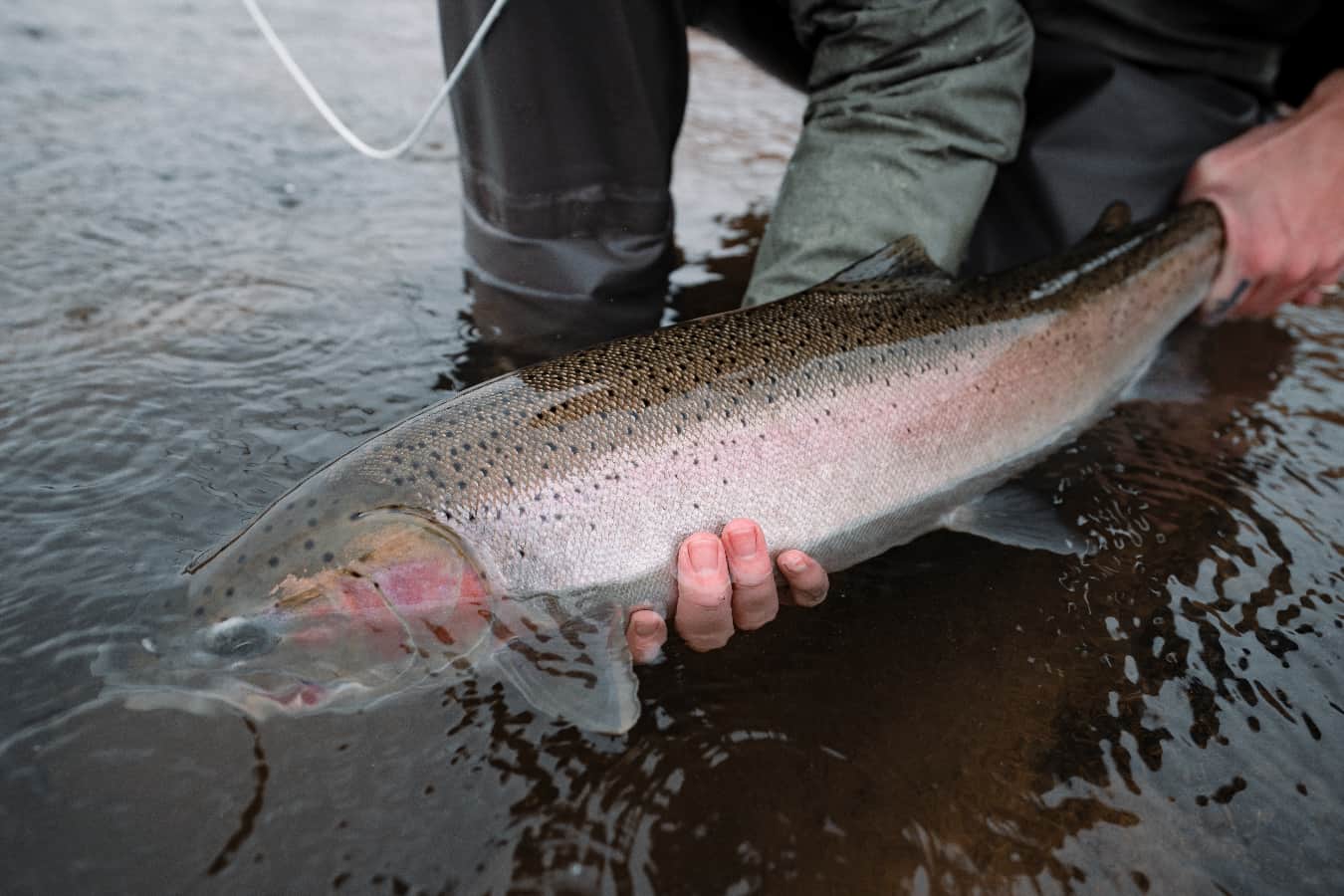
NOAA’s decision not to list OP steelhead under the ESA has conservation groups reviewing legal options and demanding immediate action from state and tribal co-managers — all while the peak of the wild winter run is underway. Image by Hone Creative
NOAA Fisheries concluded on January 14 that Olympic Peninsula steelhead (Oncorhynchus mykiss) do not warrant protection under the Endangered Species Act—even after the agency’s own status review team found the fish face a moderate risk of extinction across their range. The decision ends a review triggered by a 2022 petition from the Wild Fish Conservancy and The Conservation Angler, but it has not ended the argument over what should happen next.
The finding landed in the middle of a fraught moment. Total winter-run steelhead abundance in the four largest Olympic Peninsula basins — the Hoh, Queets, Quinault, and Quillayute — has dropped roughly 42% from the early 1990s to the 2018–2022 period, according to NOAA’s FAQ on the status review. Smolt-to-adult survival has fallen since the 1980s. Summer-run populations are so depleted they barely register in monitoring data. And the status review team’s own risk assessment judged that OP steelhead were more likely than not to reach high extinction risk within a 40- to 60-year window.
NOAA acknowledged all of that—then pointed to the fish’s continued spatial distribution, remaining habitat quality, and recent management changes by the Washington Department of Fish and Wildlife and tribal co-managers as reasons the population could persist without federal listing.
Conservation Groups Push Back
The Wild Steelhead Coalition called the decision “not an exoneration, but a wake-up call,” noting that NOAA’s finding stands in sharp contrast to the agency’s 1996 review, which found no risk of extinction. The WSC argued that the federal status review validates years of warnings about declining runs and reduced productivity, and urged anglers and managers to treat the finding as a mandate for aggressive voluntary conservation rather than a reason for complacency.
The petitioning organizations responded more sharply. Wild Fish Conservancy and The Conservation Angler issued a joint statement announcing a legal review of NOAA’s decision to determine whether it aligns with the best available science and the ESA’s statutory requirements. They are evaluating all options, language that in ESA disputes typically signals potential litigation.
WDFW, meanwhile, framed the outcome as confirmation that its existing management framework is working. The agency pointed to catch-and-release-only regulations, barbless-hook requirements, shortened seasons, hatchery reforms, and habitat restoration projects as evidence of a conservation-first approach. The NOAA finding also revealed a WDFW plan to replace the out-of-basin Chambers Creek hatchery program on the Quillayute River with a locally sourced early winter-run broodstock program, eventually releasing 50,000 smolts annually from the Bogachiel Hatchery.
The Gap Between Finding and Action
A three-part investigative series published February 4 by the Port Townsend Leader examined the paradox at the center of NOAA’s decision. The agency defined the foreseeable future as 40 to 60 years, documented a long-term downward trajectory worsened by climate change, and noted that most status review team members judged the population more likely than not to reach high extinction risk within that timeframe. Glaciers that once stabilized summer flows in Olympic Peninsula rivers are projected to disappear entirely by 2070. Ocean habitat suitable for steelhead could shrink by as much as 40% in coming decades.
Yet NOAA concluded that existing protections—habitat in Olympic National Park, state and tribal harvest restrictions, hatchery modifications—are sufficient to prevent extinction for now.
The state-tribal co-managers had pushed hard for that outcome. In a September 2025 assessment, WDFW and seven treaty tribes argued the status review process fell short of congressional standards for listing, criticizing the review team’s analysis as insufficiently grounded in co-manager data. The co-managers contended that NOAA should support their adaptive management approach rather than impose ESA restrictions on coastal communities and tribal fisheries.
What It Means on the Water
For anglers heading to the Olympic Peninsula this month—the peak of the wild winter steelhead run on the Hoh, Sol Duc, Bogachiel, and Calawah—the immediate regulatory picture is unchanged. No ESA-driven closures are coming this season. The existing framework of mandatory catch-and-release for wild fish, barbless single-point hooks, no bait, and seasonal closures on struggling systems remains in place.
But the federal government’s own scientists have now documented what steelheaders on these rivers have watched unfold for years: fewer fish, shorter seasons, more emergency closures. The Queets River within Olympic National Park closed early last season after years of missed escapement goals. The Clearwater, Quinault, Humptulips, and Chehalis systems all saw emergency shutdowns. Only the Hoh and Quillayute system stayed open through the end of the shortened season.
The WSC is urging anglers to adopt rigorous catch-and-release practices, including minimizing handling time, using rubber-mesh nets, keeping fish in the water, and considering a voluntary “one and done” ethic on days when fish are biting. With populations this low, the coalition argues, every fish that reaches its spawning gravel matters.
Whether those voluntary measures and the existing regulatory framework are enough to reverse the trajectory documented in NOAA’s own review remains the central question. The petitioners’ legal review is ongoing. The co-managers’ conservation commitments will be tested in real time as this season’s run plays out. And the fish, as always, will have the final word.