
Fishing the Hair Spider fly | Hatch Magazine
 May 28, 2026
  Comments Off on Fishing the Hair Spider fly | Hatch Magazine
If only Spider, the hapless character played by Michael Imperioli in “Goodfellas,” could have danced. If he did, he might not have taken a bullet in the foot by Tommy, who then provoked him to mouth off one last time. For Spider, let’s just say it didn’t end well.
But spiders can dance. Particularly when twitched on a 4x leader. And when they do …
I first learned about the spider from a tattered Orvis pattern index. There, in the Western Dry Flies section, there was something called a “Hair Spider” – just two opposing clumps of deer hair spun and bunched together. It reminded me of an old-timey fly I read about called a “Neversink Skater,” which is little more than a few oversize spade hackles wound on a size 16 hook. According to the description, a properly tied skater would stand up on those stiff hackles and roll and skip along the surface provoking trout to strike with great vengeance. Unfortunately, the Neversink Skater has gone largely extinct due to trends in rooster genetics. It turns out the stiff spade hackles needed to tie a proper one have been bred out of modern roosters, replaced by softer, webbier stuff used for more popular soft hackles and wets. In other words, today’s skater won’t skate.
But spun, unclipped deer hair knows all the moves. It can double axel, twerk, and possibly triple lindy. Twitch a Hair Spider through bubble lines or in slots that hurry between boulders and prepare for it to meet thy maker in a violent, water-throwing, and audible SLURP.
I began tying and fishing Hair Spiders a few years ago, casting them on local rivers and streams when golden stones or Isos became active. I quickly learned that these simple flies are, in a word, deadly. So much so, they make traditionally tied dry flies with perfectly spaced tails, wings, ribbing, and thoraxes seem almost precious. Plus, I can pump out half a dozen spiders in the time it takes for me to complete a single Catskill-style dry. Give me an hour or two, and I can fill an entire box.
Don’t get me wrong – spiders don’t always work. If fish are selectively rising to a specific hatch, they kind of suck. But not always. A few seasons ago on the Upper Delaware, with occasional March Browns duns flipping and flopping in a tasty run directly in front of me, trout got medieval on them, but always on the twitch.
And twitching is the key. A dead-drifted Spider will catch, particularly within the first second or two after it touches down when it can often prompt a reflex strike. But they are at their best when you raise your rod, leaving only the fly and maybe some tippet on the water. That’s when the spider officially enters the dance floor, and big fun can ensue. A light upstream twitch sends it skittering, imitating either a stonefly belly-flopping to lay its eggs or a mayfly struggling to break free from the surface. Whichever the case, I never knew trout could be so downright nasty when they take one.
Hair Spiders may imitate something else, too: actual spiders. Spend any time along a trout stream, particularly one with banks overhung with drooping river grasses, and spiders abound. They range from eentsy weentsy to palm-sized fishing spiders that actually catch minnows. If you’ve ever flushed a juicy spider from its lair (fishing spiders don’t build webs), it often escapes by sprinting on top of the water in a blur of legs. A rapidly twitched Hair Spider imitates this behavior nicely. Based on their over-the-top eats, trout must love chasing down real spiders as much as a peregrine falcon enjoys nailing a fat pigeon mid-air.
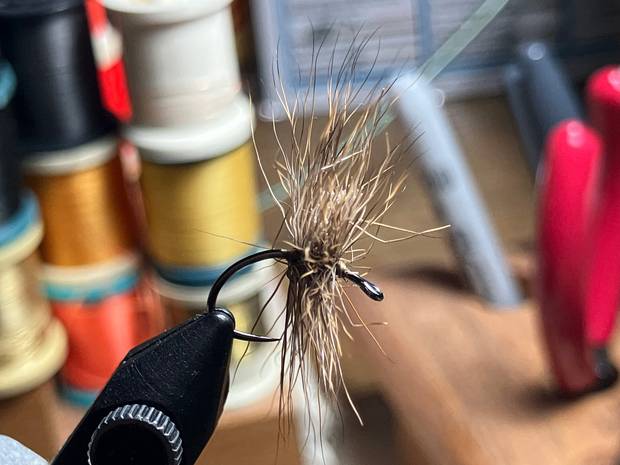
Photo: Stephen Sautner.
Yet other times, fish will take Hair Spiders with much less aplomb. A few weeks ago, I twitched one through a promising looking run and watched something ghost underneath it, track the fly for a foot, then sip it down like a midge. When I set, a surprisingly large brown shook its head. After a sumo match to keep the fish from jamming itself under a submerged ledge, a pumpkin-orange 20-incher hung in my net.
I have experimented with tying Hair Spiders on relatively tiny dry fly hooks and with various types of hair. All work to some degree, but day in day out, my favorites come in a size 12 barbless, light-wire, short-shanked Klink hook. And I use standard coarse deer hair I might tie for a Muddler, which seems to give it the proper bugginess and floatation. No two Hair Spiders look the same; some clumps of hair spin better than others and my measuring of each clump is far from exact. But it doesn’t matter. If it’s buggy, it works.
But they must float high and proud. If they start to get waterlogged and ride lower in the film, they won’t twitch properly and will lose some of their magic. Here’s a trick to quickly dry your fly passed on by my friend Chris Calabrese of Housefly Fishing in Honesdale, Pennsylvania: loop a rubber band around your wrist. When your fly gets waterlogged, place the curve of the hook around the rubber band and pull the fly by the tippet so the rubber band stretches tight. Pluck the stretched-out rubber band like a bass guitar string and water will spray out of the fly. How many plucks? I find that the first few notes of Led Zeppelin’s “How Many More Times” does the trick. After that, you can further coif the fly with some powder floatant for a last dash of waterproofing. Then cast, twitch, and watch your Hair Spider dance the night away – that is until a hungry trout crashes the party.