
MFWP Asks Flathead Anglers to Stay Vigilant for Illegal Brown Trout
 March 23, 2026
  Comments Off on MFWP Asks Flathead Anglers to Stay Vigilant for Illegal Brown Trout
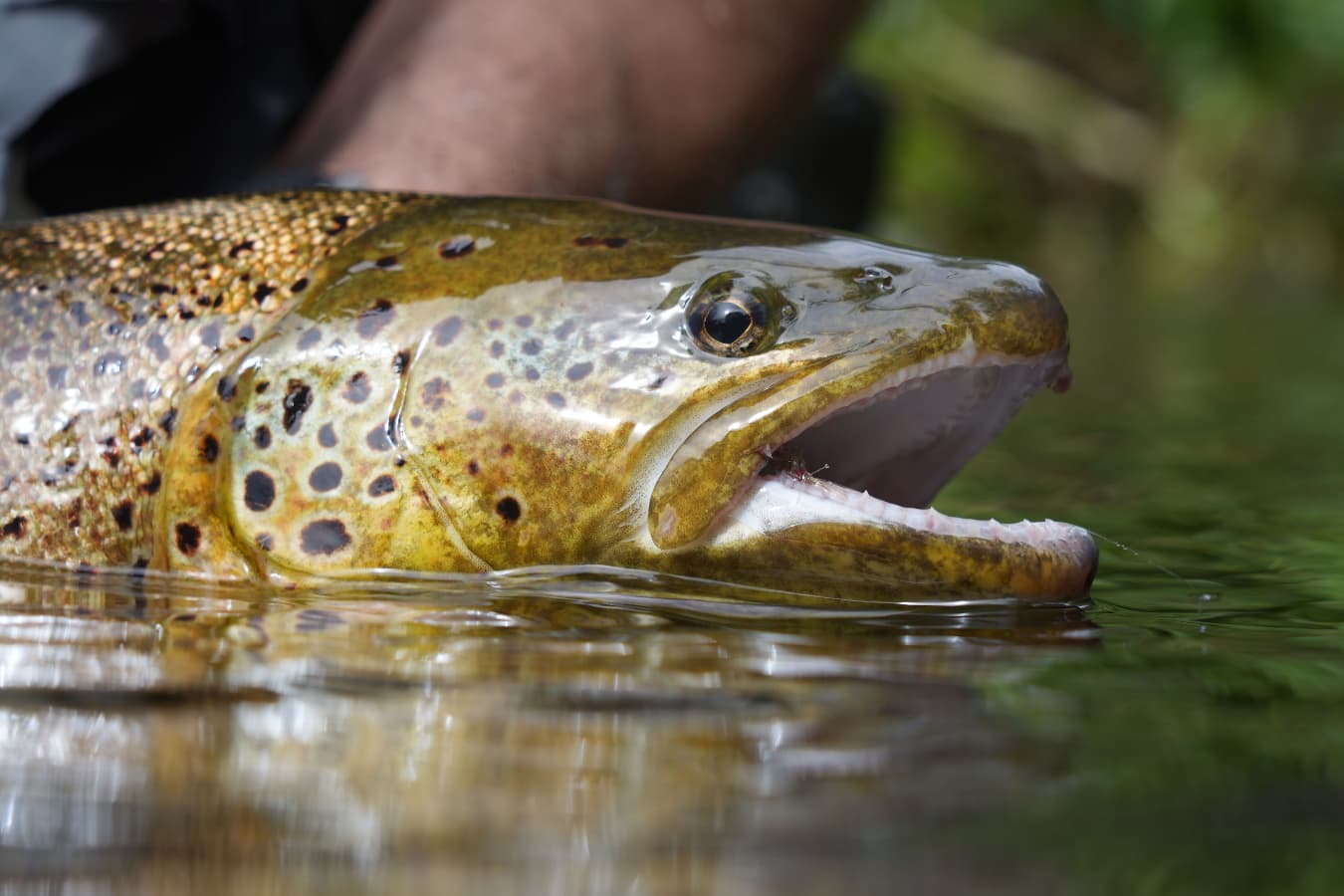
Image by goodluz
Nine months after a single brown trout photograph triggered one of northwest Montana’s most urgent fisheries investigations, Montana Fish, Wildlife & Parks says eDNA testing found no trace of the nonnative fish—but the agency isn’t standing down. As guides and anglers return to the Flathead River drainage this spring, FWP is still asking everyone on the water to kill any brown trout caught and bring the fish to the Region 1 office in Kalispell.
The Detection That Started It All
In early June 2025, a local guide reported that a client had landed a brown trout on the Flathead River between Pressentine and Teakettle fishing access sites near Evergreen. The guide photographed the fish, confirmed the kill, but did not keep the carcass—eliminating any chance for biologists to examine the fish’s otolith and trace its origin. FWP confirmed the detection via press release on July 14, 2025, and the investigation was on.
The Flathead River drainage above SKQ Dam—the Séliš Ksanka Ql’ispé Dam at the outlet of Flathead Lake—has been carefully guarded as a stronghold for native westslope cutthroat trout and federally threatened bull trout (Salvelinus confluentus). Brown trout below the dam are common; above it, the impoundment has functioned as an impassable barrier to natural upstream migration for decades. The only plausible explanation for a brown trout above the dam, said FWP Fisheries Management Biologist Kenny Breidinger, was human intervention.
Jim Vashro, former fisheries manager for FWP Region 1, noted that brown trout have already established themselves in the Thompson River and the Kootenai River downstream of Kootenai Falls through illegal introductions. “At this point, any detection of brown trout in the Flathead River has got to be some sort of bucket biology,” he said.
What eDNA Found—and Didn’t Find
To gauge the scope of the intrusion, FWP collected water samples from 13 sites between Old Steel Bridge and Teakettle Bridge, processing them for trace genetic material from brown trout. The samples, analyzed at an outside laboratory, came back negative across the board.
The odds of an eDNA hit scale with population size: a self-sustaining breeding population would almost certainly leave a signal. Thirteen consecutive misses offer meaningful reassurance.
“We’re hopeful that there’s not a brown trout population in the river,” Breidinger told the Daily Inter Lake in February 2026. He also acknowledged uncertainty about the original report itself. The guide’s photograph was angled toward the bottom of a boat with no visible landmarks, and Breidinger said he was never able to fully confirm the fish was caught where reported. “We never were able to confirm this was a legitimate report,” he said.
That ambiguity cuts both ways. If the report was accurate, the fish may have been an isolated individual rather than the leading edge of an established population. If it wasn’t caught in the Flathead drainage at all, the threat level drops further. Either way, FWP is not declaring the case closed.
Why the Threat Still Matters
Brown trout pose layered problems for native salmonids. They outcompete westslope cutthroat trout and bull trout for food and holding water and prey actively on juvenile fish. Breidinger also noted that because brown trout often spawn in fall just after bull trout in many of the same tributaries, they have been known to disturb native redds.
The drainage has survived a brush with this before. More than 25 years ago, brown trout escaped from the Creston National Fish Hatchery into Mill Creek, a Flathead tributary. FWP mounted a suppression effort that, over several years, appeared to eliminate the fish before a breeding population could take hold. Subsequent eDNA tests in Mill Creek found no brown trout. The agency’s response to the 2025 detection drew directly on that playbook.
“If there were a reproducing population of brown trout, I think we would know about it,” Breidinger said in July 2025. “We are pretty confident that this was a result of an illegal introduction and not from some unknown population.”
Moving live fish between Montana waterbodies is illegal. Violations can result in fines, imprisonment, and forfeiture of fishing and hunting licenses.
What Anglers Should Do
FWP’s standing directive for the Flathead drainage remains in effect: any brown trout caught in the Flathead River or its tributaries must be killed immediately. Anglers should retain the fish and contact the FWP Region 1 office in Kalispell at 406-752-5501, providing the date and exact location of the catch.
Brown trout are identifiable by their golden brown to yellow-brown coloration, dark spots often ringed by pale halos, and occasional red or orange spots.
“Protecting our native trout populations is a priority,” said FWP Regional Fisheries Manager Mike Hensler. “Brown trout pose a threat to native species in the Flathead drainage, and we need the public’s help to manage this invasive species.”